Mallorca · Old Town
Palma Old Town, street by street
A self-guided walking tour of the Palma Old Town, every street in two days.
Every street on the menu.
Every street in the Old Town of Palma is a line of dots you collect by walking it. I have been lying in one of them for six hundred years and I am still not finished.

At a glance
Plan your walk.
- Distance
- 44.9 km
- Time
- about 13 hours
- Streets
- 319
- Steps
- 22 streets with steps
- Start point
- La Seu
- Short on time
- Palma in one walk: 8 sights in a loop
- Phone needed while walking
- no
- Works offline
- yes
- Expires
- never
How long does it take to walk Palma's Old Town?
About 13 hours at a stroll to cover all 319 streets, 44.9 km on foot, in two days.
Is Palma's Old Town walkable?
Yes. The Old Town of Palma is 319 streets and 44.9 km of walking end to end. 22 of them include a stretch of steps.
The Old Town
Map of the Palma Old Town: every street, drawn.
Every lane inside that line is a course. The circles are fruit.
Landmarks
Sights in Palma: what I would eat first.
Landmarks are fruit. The bigger the sight, the bigger the bonus.
La Seu 1,500 points
The building every postcard of Palma is cropped around. To eat it I would need a few millennia, and I have them. Go inside when the sun is out. What the light does in there on two particular days of the year, I am not telling you.
Es Baluard 500 points
A great corner of the old city wall, thick enough that art lives in it now. I would have gone for the wall. The odd part is below, and what it was used for once, I am not telling you.
Palau de l'Almudaina 500 points
It is still the official residence of the King and Queen of Spain on the island, where they hold a reception every year, and an older fortress still shows in its shape. The walls look chewy. Look up at the top of the highest tower. What stands there, and what people say about it, I am not telling you.
Parlament de les Illes Balears 500 points
Look at the front on Carrer del Conquistador: modernist, and in no hurry at all. The lawmakers inside sit in a room that was built for something much livelier. What, I am not telling you.
La Misericòrdia 250 points
A long house that spent centuries taking in those nobody else looked after. Now it is a cultural centre, and the quiet comes free. There is a tree here worth the detour. How far it goes, I am not telling you.
Mercat de l'Olivar 250 points
The covered market, two floors of it, and the building in this town I respect most. Come hungry. What one of its bars will do with the shopping you just carried in, I am not telling you.
Monti-sion 250 points
A church front with so much stone going on that it looks like a pie crust, which is the highest praise I have. Look up over the entrance and work out who is standing on whom. Then mind the wind in Carrer del Vent beside it. Why it blows there, I am not telling you.
Plaça de Cort 250 points
The town hall square, and the point every main road on the island measures its kilometres from. I measure from lunch. Look at the long stone seat along the front of the town hall, and at the old tree in the square. Who sat on the one, and how old the other is, I am not telling you.
Plaça Major 250 points
A long, tidy rectangle with house fronts on every side: the most Castilian-looking square in this Mediterranean town, laid like a table. Stand in it and wonder what is under your shoes. Then come back in December. I am not telling you why on either count.

Eating
What to eat in Palma: actual food.
Palma has no single dish to hunt down. The island cooks out of its larder: the pig, the almond tree, the olive and the tomato, with bread under most of it. Look for those four on the plate, not for a showpiece.
Meat and fish
Sobrassada de Mallorca
Minced pork, cured raw and seasoned with salt and paprika. The name is protected, and the method is patience, which I respect.
Sources: Catálogo de Alimentos Tradicionales de las Islas Baleares (Govern de les Illes Balears / IQUA)
Ensaïmada de Mallorca
Sweet fermented dough of strong flour, eggs, sourdough and pork lard, baked. The lard is why it sits in this list and not the next one. The island's own register serves it with a cup of hot chocolate.
Sources: Catálogo de Alimentos Tradicionales de las Islas Baleares (Govern de les Illes Balears / IQUA)
Panada
A round box of baked pastry with a filling inside: meat, fish or vegetables. Mallorca eats it in Holy Week and at Easter.
Ask what is inside: the same crust holds meat, fish or vegetables.
Sources: Gran Enciclopèdia Catalana
Vegetarian
Two, because the island's pastry with a protected name, the ensaïmada, is made with pork lard by its own register's definition, so it sits with the meat. Two honest entries beat an invented third.
Gató de Mallorca
Almond cake made from three things: almond, eggs and sugar. Three ingredients. I am made of one, so to me that is a feast.
Sources: Catálogo de Alimentos Tradicionales de las Islas Baleares (Govern de les Illes Balears / IQUA)
Almendra de Mallorca
The fruit of the almond tree, grown on the island long enough to count as tradition. It is what the gató is made of.
Sources: Catálogo de Alimentos Tradicionales de las Islas Baleares (Govern de les Illes Balears / IQUA)
Vegan
Pa amb oli
Bread with a tomàtiga de ramellet tomato rubbed into it, then salt and olive oil. That is the whole recipe. Nothing to hide behind.
Order it plain: bread, tomato, salt and oil. Anything laid on top makes it a different plate.
Sources: Catálogo de Alimentos Tradicionales de las Islas Baleares (Govern de les Illes Balears / IQUA)
Trempó
A salad of tomato, onion and green pepper, all cut small. On Mallorca, capers are one of the things that go with it.
Ask what else went in: the definition leaves room for extra ingredients.
Sources: Gran Enciclopèdia Catalana, Catálogo de Alimentos Tradicionales de las Islas Baleares (Govern de les Illes Balears / IQUA)
Oliva de Mallorca
The island's own table olives, under a protected name. Olives have been grown on Mallorca since before the Romans, which makes them older than the city. I find that reassuring.
Sources: Catálogo de Alimentos Tradicionales de las Islas Baleares (Govern de les Illes Balears / IQUA)
Late breakfast
Cafè Riutort where locals go
Carrer del Carme 25
On Carrer del Carme, one street off La Rambla, and the room is locals eating local food. The sweets come from the Lluís Pérez pastry house and the sourdough from Thomas Bakeshop. The people of the quarter call the afternoon snacks spectacular. On cake, I trust the neighbours.
- Mon08:00–16:00
- Tue08:00–16:00
- Wed08:00–16:00
- Thu08:00–16:00
- Fri08:00–16:00
- Sat09:00–13:00
- Sunclosed
Sources: European Coffee Trip, Ara Balears, Majorca Daily Bulletin, The Way to Coffee
Noti Coffee Roasters where locals go
Carrer de Josep Tous i Ferrer 2
Noti roasts its own coffee on the island and pours it on Carrer de Josep Tous i Ferrer. Breakfast and lunch come off the same counter, and there is plant milk for the cups. Roasted on the island, poured here. My own supply chain is shorter still: I eat the street I lie on.
- Mon08:30–16:00
- Tue08:30–16:00
- Wed08:30–16:00
- Thu08:30–16:00
- Fri08:30–16:00
- Sat08:30–16:00
- Sunclosed
Sources: European Coffee Trip
Afternoon coffee
Nano Coffee Lab where locals go
Carrer de Can Asprer 2
A small room on Carrer de Can Asprer, just off Avinguda de Jaume III. The baristas pour beans from top European roasters such as Nomad and April, with a few pastries and sandwiches on the side. Tiny as it is, the room still found space for sandwiches, which tells me the priorities are right.
- Mon08:30–14:00
- Tue08:30–14:00
- Wed08:30–14:00
- Thu08:30–14:00
- Fri08:30–14:00
- Sat08:30–13:00
- Sunclosed
Sources: European Coffee Trip, Double Skinny Macchiato
Dinner
La Mujer de Verde come for the one thing: the vegan kitchen
Plaça de la Porta de Santa Catalina 1
Every plate is vegan, cooked by the people who opened Bon Lloc, which the Repsol guide calls Mallorca's first vegetarian restaurant. The menu changes, so I name no dish. The art on the walls changes too. Luckily nobody eats that.
- Mon13:00–16:00
- Tue13:00–16:00, 19:00–22:00
- Wed13:00–16:00, 19:00–22:00
- Thu13:00–16:00, 19:00–22:00
- Fri13:00–16:00, 19:00–22:00
- Sat13:00–16:00, 19:00–22:00
- Sunclosed
Sources: Guía Repsol, Majorca Daily Bulletin
Celler Pagès where locals go
Carrer d'en Felip Bauzà 2
A side street by La Llotja, and a house now in the hands of the third generation of one family. A Catalan columnist names it as one of only three places in Palma still cooking island food the everyday way, and Mallorca Magazin praises the traditional dishes and the fair prices. Nothing on the menu is trying to be new. Neither am I.
- Mon13:00–15:30
- Tue13:00–15:30
- Wed13:00–15:30, 19:45–22:00
- Thu13:00–15:30, 19:45–22:00
- Fri13:00–15:30, 19:45–22:00
- Sat13:00–15:30, 19:45–22:00
- Sunclosed
Dinner is Wednesday to Saturday. On Monday and Tuesday, come at lunch.
Sources: Mallorca Magazin, dBalears
Ca n'Ela where locals go
Carrer de la Mar 16
A few tables by La Llotja, in a house run by two women and named after the owner. Mallorca Magazin holds it up as a good example of vegan cooking: original dishes, a family tone. With this few tables, a plate never has far to go from the pan.
- Mon13:00–16:00, 19:00–22:00
- Tue13:00–16:00, 19:00–22:00
- Wed13:00–16:00, 19:00–22:00
- Thu13:00–16:00, 19:00–22:00
- Fri13:00–16:00, 19:00–22:00
- Sat13:00–16:00, 19:00–22:00
- Sunclosed
Sources: Mallorca Magazin
Checked 20 October 2026.
With kids
Palma with kids: short legs, big appetite.
The streets here are full of dots to collect, and a child on a hunt forgets to be tired. Here is a short loop for the smallest walkers.
- The loop
- La Seu, Plaça Major, Mercat de l'Olivar, Plaça de Cort, and back to the start
- Distance
- 2.1 km
- Time
- about 40 minutes of walking at a child's pace (3 km/h)
- Steps
- no streets with steps on the loop
- Playgrounds
- 2 near the loop
- Public toilets
- 5 near the loop
- Drinking water
- 4 near the loop
- Ice cream
- 14 near the loop
Near the loop means within 150 m of it, counted from OpenStreetMap, © OpenStreetMap contributors.

Name origin
Why it is called Palma.
Palma is the name the Romans gave it. Strabo already lists the island's two cities as Palma and Pollentia. What the name meant is still open: a palm leaf, say some; one historian ties it to the colonists Metellus settled here, who came from Picenum in Italy, where a stretch of land was called the ager Palmensis. In 902 it became Madina Mayurqa, after 1229 it simply went by the City of Mallorca, and the Roman name came back in 1715. Names come and go. The streets stay put, and so do I.
Sources: Institut d'Estudis Catalans, Joan Coromines, Onomasticon Cataloniae vol. VI, s.v. Palma, p. 142; Majorca Daily Bulletin, The name of the city: Palma, Palma de Mallorca, here we go again; Faventia, María José Pena, Faventia 26/2 (2004), abstract; Wikipedia (CA), Palma; Ajuntament de Palma, Història de la ciutat
Why here
Somebody stood here and decided.
On the plain behind the most sheltered shore of the Bay of Palma. The first, Roman town sat where the Almudaina quarter is now, inside a wall of its own, and its forum stood where Carrer de Sant Roc crosses Carrer de l'Estudi General. Both streets are on this walk, and they still meet in the same place. I would have put the forum next to a market. Nobody asked me.
Sources: Gran Enciclopèdia Catalana, Palma; Ajuntament de Palma, Història de la ciutat
Why then
When the first stone went down.
The city's own history puts its birth at 123 BC: a Roman foundation under the general Quintus Caecilius Metellus, set down right after Rome took the island. Inscriptions and finds around the cathedral show the Roman town lies directly under today's streets. More than two thousand years on the same spot. I approve. Staying put is my whole method.
Sources: Ajuntament de Palma, Història de la ciutat; Ajuntament de Palma, Historia de la ciudad; Gran Enciclopèdia Catalana, Palma; Ajuntament de Palma, Cròniques de Palma (Bartomeu Bestard, official chronicler) p. 6

Who ruled
Everyone who thought they owned this.
I outlasted all of them. It is the one thing I am good at.
- 902–1229
In 902 the Balearics joined the Umayyad emirate of Córdoba, and the Roman town took a new name: Madina Mayurqa. The governor 'Isam al-Khawlani rebuilt and enlarged the old enclosure and added mosques, public baths and inns. Early in the 11th century a new wall took in a much bigger town, the one the city now calls its Ciutat Antiga. Baths and inns first. Somebody had their priorities straight.
Sources: Ajuntament de Palma, Història de la ciutat; Gran Enciclopèdia Catalana, Palma
- 1229–1343
In 1229 Jaume I of Catalonia-Aragon arrived and took the city. A Kingdom of Mallorca was created, Madina Mayurqa became simply the City of Mallorca, and the city's own history dates the roots of today's Mallorcan society to that moment. The kingdom ended in 1343, when Pere III the Ceremonious took the island.
Sources: Ajuntament de Palma, Història de la ciutat; Ajuntament de Palma, Cròniques de Palma (Bartomeu Bestard, official chronicler) p. 210; Gran Enciclopèdia Catalana, Palma
- 1715–
In 1715 the Bourbon king Philip V took over, and his Nova Planta decrees replaced the old kingdom's institutions. The capital got its Roman name back for good, and a town council, the Ajuntament de Palma, in place of the old Great and General Council. It still runs the city. I have never run anything but out of snacks.
Sources: Ajuntament de Palma, Història de la ciutat; Gran Enciclopèdia Catalana, Palma
The emblem
What the shield means.
My drawing takes the castle with the palm tree over the waves. A castle over waves stands for a kingdom over the sea, and the castle meant is the royal Almudaina. It starts with the city's first seal: in 1269 Jaume I gave the jurats who ran the town a seal with the royal sign on one side and his castle of the Almudaina on the other, and a document of 1312 most likely put the two together on one quartered shield. The palm came later, a 15th-century humanist addition from the days when scholars tied the city back to Roman Palma: a palm for Palma, what heralds call canting arms: a picture that puns on the name. A palm tree, and not one date on it. I checked.
Sources: Wikipedia (CA), Escut de Palma; Ultima Hora, Palma: el origen del murciélago del escudo de Ciutat; Heràldica i vexil·lografia de les Illes Balears, Gabriel Bibiloni, Els símbols de Palma
Emblem: Original artwork for Cobble Gobble — no third-party source

Three facts
Three things I know about this place.
Many of the grand houses keep a courtyard, a pati, behind the front door. Until mass tourism they were half public, and many can still be seen through the grilles of the doorway. Look in, do not go in. The grille is the menu, not the meal.
Sources: Ajuntament de Palma, Cròniques de Palma (Bartomeu Bestard, official chronicler) p. 132
La Rambla and the Passeig del Born were a stream bed. The torrent sa Riera came in through the wall, ran down La Rambla and on to the Born. In 1613 work began to send it round outside the walls, the old bed inside was filled with earth, and the Born turned into a wide promenade. A stream bed turned into a promenade. I would simply have waited for it to dry up.
Sources: Ajuntament de Palma, Cròniques de Palma (Bartomeu Bestard, official chronicler) p. 11; Gran Enciclopèdia Catalana, Palma
On Carrer de l'Almudaina an old arch still stands over the street: a gate of the old city wall. The city's own history calls it a gate of the first, Roman town; the Catalan encyclopedia counts it among the few things left of the Islamic city. The historians disagree, and the arch is not saying. I asked.
Sources: Ajuntament de Palma, Història de la ciutat; Gran Enciclopèdia Catalana, Palma; Mallorca Magazin, Auf einer Zeitreise über Mallorca
Street words
What the names on the signs mean.
- Carrer
- Street. Nearly every sign on this walk opens with it, so you are fluent by the second corner.
- Plaça
- Square. The open ground between the lanes, where a rock can finally spread out.
- Costa
- Slope. Here a Costa is a steep lane, not a beach: Costa de Santa Creu, Costa de la Pols. Up is the hard way. I prefer the way back.
- Can
- The house of. Costa de Can Muntaner is the slope by the house of the Muntaners; Carrer de Can Martí Feliu, the street by Martí Feliu's house.
The size of it
Walk it in two days: Palma in numbers.
Counted from the streets in the level itself, not from a guidebook.
- 319streets
- 2,229dots
- 36.0km of street
- 44.9km on foot
- 13hours at a stroll
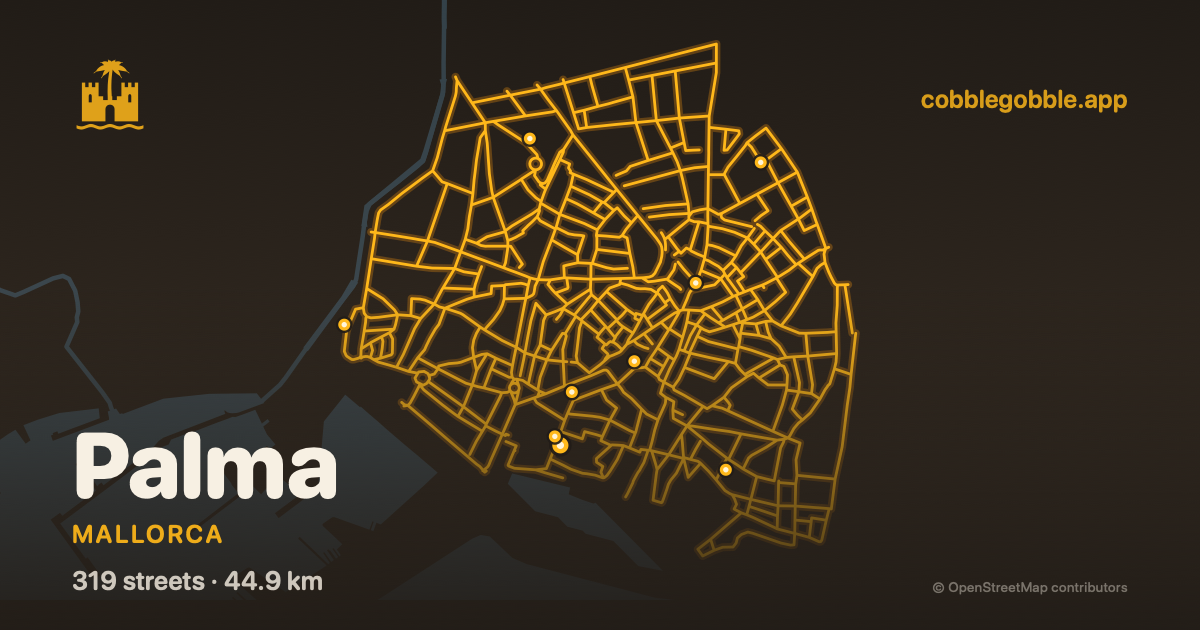
Use this map in your article or blog: free, with a credit link.
The game
Your first city is free.
Cobble Gobble is a walking game for iPhone. Claim any city as your free one. Every other city is a one-time purchase you keep for good, Family Sharing included, and a city you own plays fully offline.