Spain · Old Town
Barcelona Old Town, street by street
A self-guided walking tour of the Barcelona Old Town, every street in one day.
Every street on the menu.
Every street in the Old Town of Barcelona is a line of dots you collect by walking it. I have been lying in one of them for six hundred years and I am still not finished.

At a glance
Plan your walk.
- Distance
- 28.3 km
- Time
- about 8 hours
- Streets
- 222
- Steps
- 1 street with steps
- Start point
- Catedral de la Santa Creu i Santa Eulàlia
- Short on time
- Barcelona in one walk: 8 sights in a loop
- Phone needed while walking
- no
- Works offline
- yes
- Expires
- never
How long does it take to walk Barcelona's Old Town?
About 8 hours at a stroll to cover all 222 streets, 28.3 km on foot, in one day.
Is Barcelona's Old Town walkable?
Yes. The Old Town of Barcelona is 222 streets and 28.3 km of walking end to end. 1 of them include a stretch of steps.
The Old Town
Map of the Barcelona Old Town: every street, drawn.
Every lane inside that line is a course. The circles are fruit.

Landmarks
Sights in Barcelona: what I would eat first.
Landmarks are fruit. The bigger the sight, the bigger the bonus.
Catedral de la Santa Creu i Santa Eulàlia 1,500 points
In 1417 they closed the front with a plain wall, just for the moment. The moment lasted until the end of the 19th century, when an industrialist, Manuel Girona, offered to pay for a façade. Provisional, for nearly five centuries. Finally, someone at my pace. Inside, some of it is alive. I am not telling you what.
Basílica de Santa Maria del Mar 500 points
Foreigners counted three cathedrals in this city, and this church was one of them. The locals added nicknames: the Cathedral without a cloister, the Fishmongers' Seat, the Seat of the Sea. Keep your eyes on the door and on the glass. I am not telling you why.
La Rambla 500 points
The name comes from the Arabic ramla, sandy ground. I checked: it is paved now. An estimated 240,000 walkers go along it on an ordinary weekday. In the Pla de la Boqueria they cross Joan Miró's 1976 pavement, made to greet visitors arriving by sea. At the top end, stop. I am not telling you why.
Palau de la Música Catalana 500 points
Inside, the skylight stands for the sun and Wagner's Valkyries break out of the ceiling. A bust of Anselm Clavé faces one of Beethoven and neither has blinked yet. I respect that. Something happens here every 26 December, and it has passed its hundredth year. I am not telling you what.
Museu Picasso 250 points
It opened in 1963 under a name that was not his. A whole house of Picasso, with somebody else on the door. I am not telling you whose, or why. I eat the street outside, and the street has no opinion.
Palau Centelles 250 points
A count's will left everything to one great-nephew and the county to another. The fight over who owned this palace went to law and was settled in 1628. It houses Catalan public institutions now, and I only want the street in front of it. Nobody has sued. The family name has its own tale. I am not telling you how it goes.
Palau Savassona 250 points
A baron's house on Carrer de la Canuda. In 1796 the painter Francesc Pla, El Vigatà, covered its dining room with murals, among them the gods Mars and Venus. A whole room for eating and no street in it. I do not see the point. The house is private, so I make no offer about the door. What moved in later is the good part, and I am not telling you what.
Plaça de Catalunya 250 points
This was an open esplanade in front of one of the city's main gates, before cafés, theatres and fairground booths filled it. On the corner of Carrer de Pelai, the Cafè Zurich has been where this city meets and meets again since 1920. Everyone here is waiting for somebody. I am here for the paving. One thing in this square looks like a building mistake. It is not, and I am not telling you which.
Plaça Reial 250 points
In 1902 a Magic Fountain replaced the Three Graces: coloured water under 96 arcs of light, twenty-seven years before the one on Montjuïc. By 1925 it clearly did not work, and the Three Graces came back. Patience outlasts magic. I could have told them. Now look at what lights the place after dark. I am not telling you who got that job.

Eating
What to eat in Barcelona: actual food.
There is no one Barcelona dish to hunt for. What this city cooks is the Catalan home kitchen: the pot that fed the houses, vegetables cooked in the embers, a stew with mushrooms in it. Look for it at midday, on a market counter or in a dining room for people on their lunch break. You take the plates. I take the streets between them.
Meat and fish
Escudella i carn d'olla
Once the most usual meal in the homes of Catalonia, says the Gran Enciclopèdia Catalana. Carn d'olla means meat from the pot. The name is the method.
Sources: Gran Enciclopèdia Catalana
Fricandó
A meat stew in a sauce of onion, tomato and herbs, with mushrooms in it, usually moixernons. Moixernons. I would like a street with that name.
Sources: Gran Enciclopèdia Catalana
Botifarra
The Catalan sausage: a pork or beef casing, stuffed. La Plata on Carrer de la Mercè serves it on a skewer.
Sources: Gran Enciclopèdia Catalana
Vegetarian
Only one here, because the vegan list is yours as well: escalivada, samfaina and calçots carry no meat at all.
Crema catalana
A custard with sugar spread on top and burned, traditionally with a red-hot iron. It also goes by crema cremada, and by crema de Sant Josep, after the feast it belongs to. A crust you break with a spoon. Mine takes frost.
Sources: Gran Enciclopèdia Catalana
Vegan
Escalivada
Aubergines, peppers, onion and tomato cooked in the embers, then peeled, torn into pieces and dressed with oil and salt. It takes embers and patience. I can supply the second.
Sources: Gran Enciclopèdia Catalana
Samfaina
Tomato, pepper, onion and aubergine, fried gently in the pan, sometimes with parsley and black pepper. The aubergine is in two dishes on this list. It gets around.
It often comes alongside meat or fish. Ask for it on its own.
Sources: Gran Enciclopèdia Catalana
Calçot
A shoot of the white onion, grown for one purpose: to be roasted in the embers and eaten. An onion with a career plan.
Sources: Gran Enciclopèdia Catalana
Late breakfast
Bar Joan the old one
Avinguda de Francesc Cambó 16
A family bar in a corner of the Mercat de Santa Caterina since 1984, says the Catalan daily Ara. It serves a homemade midday menu to its regulars, one of them there since the first day. Lonely Planet gives the week a rhythm: arròs negre on Tuesdays, paella on Thursdays.
- Mon07:30–15:30
- Tue07:30–15:30
- Wed07:30–15:30
- Thu07:30–15:30
- Fri07:30–15:30
- Sat07:30–15:30
- Sunclosed
Sources: Ara, Time Out Barcelona, Lonely Planet
Right Side Coffee Bar where locals go
Carrer de l'Arc de Sant Ramon del Call 11
A roaster's own bar down a narrow alley in the Call, the old Jewish quarter, behind the cathedral. Its people travel to the plantations, choose the coffee there and roast it every week, says Time Out. Double Skinny Macchiato tasted cherry and almond in the cup, and European Coffee Trip lists breakfast too.
- Mon09:00–17:00
- Tue09:00–17:00
- Wed09:00–17:00
- Thu09:00–17:00
- Fri09:00–17:00
- Sat10:00–18:00
- Sun10:00–18:00
On public holidays it keeps weekend hours: 10:00 to 18:00.
Sources: Time Out Barcelona, Double Skinny Macchiato, European Coffee Trip, Barista Magazine
Transatlàntic where locals go
Plaça de Víctor Balaguer 3
A dining room on Plaça de Víctor Balaguer cooking workers' lunch menus, the real kind, says Time Out. In a Born full of places made for visitors it goes unnoticed, a refuge for workers and pensioners. Going unnoticed is my whole career. I am the floor.
A weekday lunch house: it is closed at the weekend.
Sources: Time Out Barcelona
Afternoon coffee
Tostaderos Bon Mercat Llibreteria where locals go
Baixada de la Llibreteria 1
A roaster's café and shop on Baixada de la Llibreteria. The cup holds the same arabica blend it roasts for the city's bars and restaurants, says Time Out. Falstaff counts few seats: most people order to go. Takeaway is the one format I never managed.
- Mon08:00–20:00
- Tue08:00–20:00
- Wed08:00–20:00
- Thu08:00–20:00
- Fri08:00–20:00
- Sat08:00–20:00
- Sunclosed
Sources: Time Out Barcelona, Falstaff
Dalston Coffee where locals go
Carrer de les Ramelleres 16
A one-man bar on Carrer de les Ramelleres, just off the top end of La Rambla: barely a counter, two small tables outside, says Time Out. It roasts its own beans in La Garriga. Espresso comes from the machine, filter from a Moccamaster. One person, two ways to brew.
Sources: Time Out Barcelona
Xiloteca where locals go
Carrer de la Neu de Sant Cugat 6
A tiny coffee bar and ceramics shop on Carrer de la Neu de Sant Cugat, in the Born. Inside there is just room for the small bar and shelves of colourful mugs, jugs and bowls, says Double Skinny Macchiato. The beans are roasted in Zaragoza, with two single origins on espresso. The Ethiopian one tasted of milk chocolate and bergamot as a cortado. Fired clay on every shelf. Stone with a gentler upbringing.
- Mon08:00–18:00
- Tue08:00–18:00
- Wed08:00–18:00
- Thu08:00–18:00
- Fri08:00–18:00
- Sat09:00–18:00
- Sun09:00–18:00
Sources: European Coffee Trip, Double Skinny Macchiato
Dinner
La Sosenga where locals go
Carrer d'Amargós 1
A small, plain room on Carrer d'Amargós, a pedestrian alley a few steps from Plaça de Catalunya. A pedestrian alley is my favourite kind of plate. It opened in 2023 to cook Catalan food with an identity of its own, and Directo al Paladar counted 97 percent of its guests from Barcelona, Catalonia or elsewhere in Spain. Real Catalan cooking, says Time Out: no tacos, no octopus on mash.
- Monclosed
- Tue13:00–16:45
- Wed13:00–16:45
- Thu13:00–16:45, 20:00–23:45
- Fri13:00–16:45, 20:00–23:45
- Sat13:00–16:45
- Sunclosed
Dinner only on Thursday and Friday. Tuesday to Saturday it serves lunch; Sunday and Monday it is shut.
Sources: Michelin Guide Spain, Guía Repsol, Directo al Paladar, Time Out Barcelona
La Plata where locals go
Carrer de la Mercè 28
A bar on Carrer de la Mercè with a menu that does not change: fried small fish, a botifarra skewer, tomato salad with onion and arbequina olives, anchovies. Ara says that is exactly why everyone comes back. Time Out compares it to the fishermen's taverns of old.
- Mon11:00–15:00, 18:00–23:00
- Tue11:00–15:00, 18:00–23:00
- Wed11:00–15:00, 18:00–23:00
- Thu11:00–15:00, 18:00–23:00
- Fri11:00–15:00, 18:00–23:00
- Sat11:00–15:00, 18:00–23:00
- Sunclosed
Vegetarian or vegan: the tomato salad is your plate.
Sources: Ara, Time Out Barcelona
Petra where locals go
Carrer dels Sombrerers 13
A little restaurant on Carrer dels Sombrerers, right in the shadow of Santa Maria del Mar. Frommer's says the two owners make you feel welcome and the comfort food fills you up. Eggs lead the menu: with salt cod and spinach, with octopus and kimchi, with bacon and chips. Time Out calls it low cost, informal and cosy. I take the alley outside as my starter.
- Mon13:00–16:00, 19:30–22:30
- Tue13:00–16:00, 19:30–22:30
- Wed13:00–16:00, 19:30–22:30
- Thu13:00–16:00, 19:30–22:30
- Fri13:00–16:00, 19:30–23:00
- Sat13:00–16:00, 19:30–23:00
- Sun13:00–16:00
Dinner every day but Sunday. On Sundays it serves lunch only.
Sources: Frommer's Barcelona, Time Out Barcelona
Checked 5 November 2026.
With kids
Barcelona with kids: short legs, big appetite.
The streets here are full of dots to collect, and a child on a hunt forgets to be tired. Here is a short loop for the smallest walkers.
- The loop
- Catedral de la Santa Creu i Santa Eulàlia, Plaça de Catalunya, La Rambla, Plaça Reial, and back to the start
- Distance
- 2.1 km
- Time
- about 40 minutes of walking at a child's pace (3 km/h)
- Steps
- no streets with steps on the loop
- Playgrounds
- 4 near the loop
- Public toilets
- 8 near the loop
- Drinking water
- 16 near the loop
- Ice cream
- 25 near the loop
Near the loop means within 150 m of it, counted from OpenStreetMap, © OpenStreetMap contributors.

Name origin
Why it is called Barcelona.
Nobody knows what the name Barcelona means. Coromines, the great Catalan place-name authority, declined to give an etymology at all, out of respect for a linguistic science in no state to clear it up. The name is older than the Romans: Iberian drachmas of the 2nd century BC already carry it, in Iberian letters read as barkeno, and the colony Latinised it to Barcino. The old learned legend sends Hercules instead: the last of his nine boats reached this beach, and the name may come from that ninth boat, the barca nona. A legend, not an etymology. Nobody has cracked this name. As a stone, I respect that.
Sources: oncat.iec.cat; ca.wikipedia.org; es.wikipedia.org; www.enciclopedia.cat

Why here
Somebody stood here and decided.
The Romans wanted a spot between Emporiae to the north and Tàrraco to the south, and they took the top of Mount Taber: a small hill facing the sea and looking over the plain, where Plaça de Sant Jaume is today. It rises on the coast between the mouths of the Besòs and the Llobregat, and both river valleys give an easy way inland. The land around it was extensive and fertile, and the Via Augusta and the trade routes tied it to the rest of the empire. A small hill with roads running off it. I call that a well-laid table.
Sources: barcelona.cat; www.enciclopedia.cat; barcelona.cat

Why then
When the first stone went down.
Between 15 and 13 BC, says the city council, and the Generalitat gives the same years. It also points to a tombstone in the city's history museum that spells out the full name: Iulia Augusta Faventia Paterna Barcino. Around 10 BC, says that same museum. All of them land in the late 1st century BC, when Augustus was reorganising the Iberian peninsula to tighten his control and work its land. The colony got tax privileges its older neighbours such as Bètulo lacked, and its first settlers were free citizens from the Italian and Gaulish provinces. Two dates, a few years between them. I am a stone. To me that is one date.
Sources: barcelona.cat; patrimoni.gencat.cat; ajuntament.barcelona.cat p. 6; barcelona.cat

Who ruled
Everyone who thought they owned this.
I outlasted all of them. It is the one thing I am good at.
- 15 BC–475
Rome, from Augustus on: a planned grid with sewers, a temple, a forum and a city wall. Roman rule ended in 475, when the region passed to the Visigothic king Euric. Streets planned before anybody walked them. I approve.
Sources: barcelona.cat; www.enciclopedia.cat
- 878–1137
The counts of Barcelona. In 878, at the Council of Troyes, the Frankish king invested Guifré el Pelós, Wilfred the Hairy, with Barcelona, Girona and Besalú, and the line starts with him. In the 11th century Ramon Berenguer I proclaimed the Usatges de Barcelona, the first Catalan legislative text. In 1137 a pact between Ramon Berenguer IV and Ramiro the Monk turned the county house into the royal dynasty of Aragon. The Hairy. A stone takes centuries to manage even moss.
Sources: www.enciclopedia.cat; barcelona.cat; www.barcelona.cat p. 13
- 1249–1714
The Council of One Hundred, under the count-kings. In 1249 King James I agreed to the first municipal government, the Council of One Hundred followed in 1265, and in 1284 Peter the Great granted the regime in perpetuity. A decree, the Nova Planta, abolished it in 1714. The Council of One Hundred had 128 members. I count every dot I eat. I have questions.
Sources: www.barcelona.cat p. 17; barcelona.cat; www.enciclopedia.cat
- 1854–
The modern city, and a map decided from Madrid. The walls were pulled down in 1854. The council and the bourgeoisie wanted Rovira's plan, with streets running star-like towards a great square at today's Plaça de Catalunya, and people liked it more. In 1859 a royal order approved Cerdà's project instead, a right-angled grid, because the royal house in Madrid preferred it. Plaça de Catalunya is the seam: your level reaches it, and the grid starts behind it. Nobody asked me. I would have eaten either.
Sources: ca.wikipedia.org; www.enciclopedia.cat; de.wikipedia.org
The emblem
What the shield means.
A quartered lozenge: a full red cross on silver in the first and fourth quarters, four red pales on gold in the second and third, a royal crown on top. That is the official blazon, adopted by the city council on 6 April 2004. The cross is the Cathedral's and the stripes are the count's Royal House, the two institutions that had ruled the city. By 1395 the councillors were calling the red cross, by then in Saint George's form, the sign of the City, its origin already forgotten. The oldest known shield sits on a document of 1289, with two pales, perhaps three. Official seals keep two from the 14th to the 18th century, and four become general only in the 19th. The crown stayed off for five centuries and more: the pales were already royal arms. The stripes took centuries to double. I find that brisk.
Sources: bcnroc.ajuntament.barcelona.cat; www.barcelona.cat p. 19; bcnroc.ajuntament.barcelona.cat
Emblem: Original artwork for Cobble Gobble — no third-party source

Three facts
Three things I know about this place.
Four Roman columns, 12 metres high, are hidden in the courtyard of a Gothic palace at Carrer del Paradís 10. They come from the temple the Romans built for Augustus at the top of Mount Taber. One of the four is a transfer: a mid-20th-century restoration brought in a column that had for some time stood in Plaça del Rei. Columns are off my menu. The street that hides them is not.
Sources: barcelona.cat; barcelona.cat
The Roman wall is today the city's most extensive monument. It runs along Plaça Nova, Avinguda de la Catedral, Carrer de la Tapineria, Plaça de l'Àngel and Carrer del Sots-tinent Navarro, and at Plaça Nova the gate towers stand round, about 7 m across. Late in the 3rd century it was doubled, and it came to carry about eighty towers. It stands upright, so it does not count as a street. I have complained.
Sources: barcelona.cat p. 1; www.enciclopedia.cat
Plaça de Sant Jaume sits on the Roman forum, with the Palau de la Generalitat on one side and the Casa de la Ciutat on the other. The city hall goes back to 1369, when its Saló de Cent was begun, and it has two faces: the main, Neoclassical one was built in 1847, and the Gothic one is still there on Carrer de la Ciutat. To enlarge it, the church of Sant Miquel behind it came down in 1868, at what is still Plaça de Sant Miquel. The doorway went to the basilica of la Mercè on Carrer Ample and the bell tower to the church of la Concepció on Carrer d'Aragó, both beyond this level's edge. The floor, a Roman bath mosaic of black fish and sea monsters, went to the Museu d'Arqueologia de Catalunya. Even I keep what I eat in one place.
Sources: www.barcelona.cat; ca.wikipedia.org
Street words
What the names on the signs mean.
- Carrer
- Street. It is on nearly every sign here, and it is most of my meal.
- Plaça
- Square. The word with the tail on its c. A whole plate at once.
- Baixada
- A way down: a street that descends. You do the legs. I do the eating.
- Passatge
- A passage, usually a short cut between two streets. A snack.
- Placeta
- A little plaça. One bite.
The size of it
Walk it in a day: Barcelona in numbers.
Counted from the streets in the level itself, not from a guidebook.
- 222streets
- 1,502dots
- 22.8km of street
- 28.3km on foot
- 8hours at a stroll
3% of the streets here, by length, are cobbles or setts: number 58 of 59 Old Towns measured.
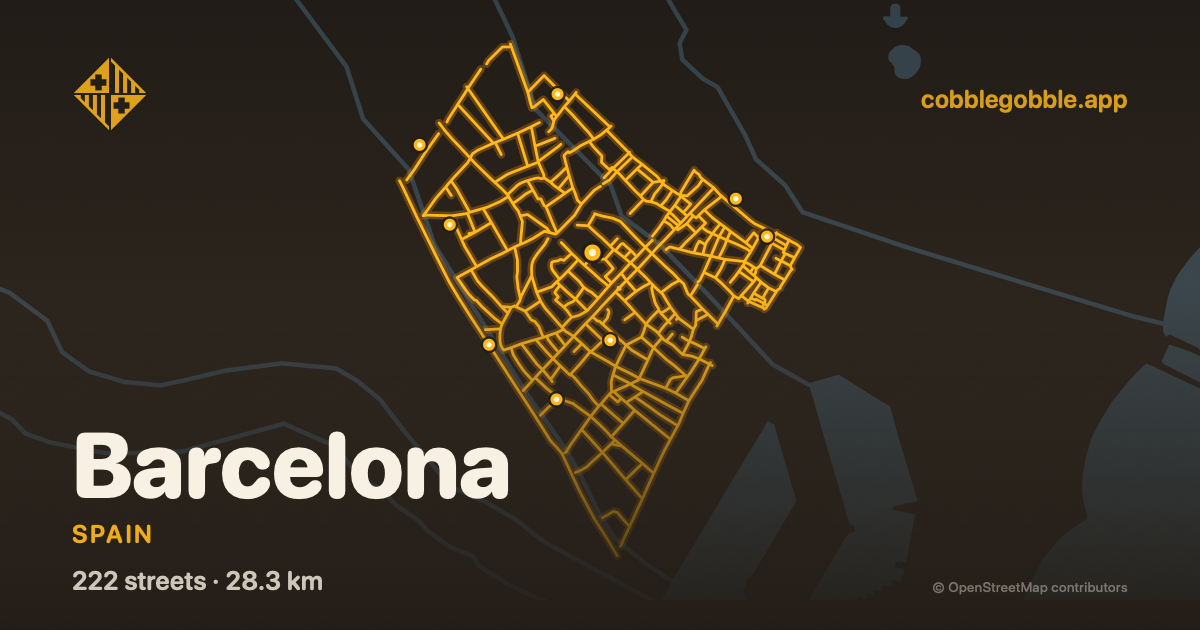
Use this map in your article or blog: free, with a credit link.
The game
Your first city is free.
Cobble Gobble is a walking game for iPhone. Claim any city as your free one. Every other city is a one-time purchase you keep for good, Family Sharing included, and a city you own plays fully offline.