Schleswig-Holstein · Old Town
Lübeck Old Town, street by street
A self-guided walking tour of the Lübeck Old Town, every street in one day.
Every street on the menu.
Every street in the Old Town of Lübeck is a line of dots you collect by walking it. I have been lying in one of them for six hundred years and I am still not finished.

At a glance
Plan your walk.
- Distance
- 23.0 km
- Time
- about 6.5 hours
- Streets
- 93
- Steps
- 2 streets with steps
- Start point
- Holstentor
- Short on time
- Lübeck in one walk: 8 sights in a loop
- Phone needed while walking
- no
- Works offline
- yes
- Expires
- never
How long does it take to walk Lübeck's Old Town?
About 6.5 hours at a stroll to cover all 93 streets, 23.0 km on foot, in one day.
Is Lübeck's Old Town walkable?
Yes. The Old Town of Lübeck is 93 streets and 23.0 km of walking end to end. 2 of them include a stretch of steps.
The Old Town
Map of the Lübeck Old Town: every street, drawn.
Every lane inside that line is a course. The circles are fruit.
Landmarks
Sights in Lübeck: what I would eat first.
Landmarks are fruit. The bigger the sight, the bigger the bonus.
Holstentor 1,500 points
A city gate, built from 1464 to 1478 by the city's master builder, Hinrich Helmstede. Over the arch on the field side, a Latin line from 1871 wishes the town unity within and peace without. Stand in front of it for a minute and something starts to look a little odd.
Dom 500 points
The Dom sits at the southern tip of the Old Town, in what grew up as the cathedral quarter, and the streets on the way there are a good long meal. Why does it stand on exactly this spot? An animal is said to have chosen it. Which animal, I am not telling you.
Niederegger 500 points
On Breite Straße, right across from the Rathaus, in the house the founder bought in 1822. For a rock with my appetite, the shop window is the most dangerous spot in the Old Town. Go up a floor: a few famous faces are waiting for you there, standing very still. Whose faces, I am not telling you.
St.-Marien-Kirche 500 points
The highest brick vault in the world, 38.5 metres above the floor, and the mother church of Brick Gothic: around 70 churches around the Baltic Sea were built with it as their model. That much brick, stacked that high. I would not know where to start. The best thing here is not the biggest, though. It is a very small one. I am not telling you what.
Heiligen-Geist-Hospital 250 points
Slim turrets line the front. Nobody can climb them and they do nothing at all: they are there for looks, which I respect in a building. Behind them stands one of the oldest social institutions in Europe. Inside, a surprise is waiting.
Johannis-der-Täufer-Brunnen 250 points
A saint in bronze on shell limestone, standing in a schoolyard. He looks very sure of himself. I have questions.
Malerwinkel 250 points
A small green across a footbridge from the Old Town, a leftover spur of the old city ramparts. Sit on the bank, look back over the river and chew on the skyline for a while. It is not telling you the whole truth. Neither am I.
Museumsquartier Sankt Annen 250 points
Old walls from 1502, and beside them a modern art hall, built in 2003 on the foundation walls of a church that had stood as a ruin for almost 130 years. New on old, like a fresh lid on an old pie. Somewhere in here is the most precious work of art in the city. I am not telling you what.
Eating
What to eat in Lübeck: actual food.
Lübeck eats like the port it was. Fish from the sea, meat salted and smoked to keep, almonds and sugar that came in by ship. The almonds and the sugar became marzipan, and the rest of the table gathers around it. Sugar arriving by ship. I would have waited on the quay with my mouth open.
Meat and fish
Two, and between them they cover the old table: Lübeck's classic food is fish, cured meat, cream and almonds. The Labskaus brings the fish along on the plate, and the ham is the cured meat.
Labskaus
The old sailors' dish: corned beef brisket put through the mincer with potatoes, onions and spices, then plated with beetroot, gherkins, matjes, rollmops and a fried egg. Along this coast it sits near the top of the menu. Some call it the North's greatest speciality, others treat it with a certain respect. Meat, fish and an egg on one plate. Indecision, solved.
Sources: Michael Müller Verlag, TRAVELBOOK, MERIAN, Schlemmer Atlas (Busche Verlag)
Holsteiner Katenschinken
Holstein ham, cut round, salted by hand and cold smoked slowly over beechwood. From delivery to a ripe ham takes at least four months, all of it inside Schleswig-Holstein, and the protected area takes in the whole Land, Lübeck included. The register says it smells and tastes of natural smoke, and the fat tastes slightly of nuts. Four months for one ham. Finally, somebody who cooks at my speed.
Sources: eAmbrosia (European Commission), Official Journal of the European Union C 109 (8.4.2011)
Vegetarian
Two. Lübeck's classic table is fish, cured meat, cream and almonds. Take away the fish and the meat, and what stays is the dairy and the almonds: a cake and a cheese.
Lübecker Nusstorte
Cream, walnuts and marzipan in one cake. A travel magazine calls it legendary, a restaurant guide a classic, and a guidebook says no visit to the Old Town is complete without at least one slice of marzipan, nut and cream cake. At least one. I like a rule with a floor and no ceiling.
Cream cakes are sometimes set with gelatine. Ask at the counter.
Sources: Der Feinschmecker, MERIAN, Michael Müller Verlag
Holsteiner Tilsiter
A semi-hard cow's milk cheese, treated with a red smear culture all through its ripening, which lasts at least five weeks. Young it is mild and lightly spicy, kept longer it turns strong and piquant. Schleswig-Holstein has made it since about 1920. Waiting turns it from mild to piquant. Waiting has never changed me.
The specification does not say which rennet is used. Ask at the counter if that matters to you.
Sources: eAmbrosia (European Commission), Official Journal of the European Union C 288 (2012)
Vegan
One. The classic table runs on fish, cured meat, cream and almonds, and only the almonds come without an animal. They come as marzipan, which a guidebook calls the city's most important speciality. One dish, then, but the big one.
Lübecker Marzipan
Elsewhere marzipan is a filling, inside Dominosteine and Mozartkugeln. Here it is the main event: pure marzipan, a protected name since 1996 that guarantees where it comes from. A guidebook notes that sugar may make up at most a third of it. A sweet with a sugar limit. This city has principles.
Pick the plain piece. A chocolate coating can bring milk with it.
Sources: eAmbrosia (European Commission), Michael Müller Verlag, t-online
Late breakfast
UTER Konditoreibar come for the one thing: the lemon-curd tartlet
Fleischhauerstraße 62
A guidebook calls these tartlets a poem. They come out of a glass bakery, so the whole making happens in plain sight, and a restaurant guide singles out its modern cakes and tortes. Breakfast runs from bread baked in the house and homemade spreads to eggs Benedict. Watching pastry get made is my idea of a thriller.
- Mon09:30–17:30
- Tue09:30–17:30
- Wed09:30–17:30
- Thu09:30–17:30
- Fri09:30–17:30
- Sat09:00–17:30
- Sun09:00–17:30
Book a table. It fills up fast.
Sources: Der Feinschmecker, Michael Müller Verlag, MERIAN, AhoiMaike
Konvent Café im Aegidienviertel where locals go
Sankt-Annen-Straße 1
Breakfast in the shade of the Aegidienkirche. The house roasts its own coffee and bakes its own bread, and a guidebook calls the open sandwiches here the tastiest in the city. In German they are Stullen. A Stulle is a slice of bread with ambitions.
- Monclosed
- Tue09:30–18:00
- Wed09:30–18:00
- Thu09:30–18:00
- Fri09:30–18:00
- Sat09:30–18:00
- Sun09:30–18:00
Head for the café at the Aegidienkirche, not the second Konvent by the Dom.
Sources: Michael Müller Verlag, AhoiMaike
Afternoon coffee
Cycle Roasters Fleischhauerstraße come for the one thing: the coffee roasted by the house
Fleischhauerstraße 44
The beans are roasted at the house's own roastery on the Kulturwerft Gollan grounds, where it also teaches barista courses, and poured here in a small café on Fleischhauerstraße. A guidebook calls the coffee excellent, and a travel magazine says everything here turns on the bean. A whole café built around one small bean. I understand focus.
- Mon10:00–18:00
- Tue10:00–18:00
- Wed10:00–18:00
- Thu10:00–18:00
- Fri10:00–18:00
- Sat10:00–18:00
- Sunclosed
Sources: Michael Müller Verlag, MERIAN, AhoiMaike
Dinner
Restaurant Blechtrommel where locals go
Glockengießerstraße 65
Polish cooking a few hundred metres from the Günter Grass House, under a name that nods to his novel The Tin Drum. Bigos, pierogi, Königsberger Klopse, goulash from the kettle. A 2024 guidebook found a whole dinner here for about 8 to 10 euros, and warned that it takes some patience. Patience I have. I am a rock.
- Monclosed
- Tue17:30–22:00
- Wed17:30–22:00
- Thu17:30–22:00
- Fri17:30–22:00
- Sat17:30–22:00
- Sun17:30–22:00
Sources: Michael Müller Verlag
Café Affenbrot where locals go
Kanalstraße 70
A vegetarian café with organic cooking and vegan dishes on the same menu, in bright rooms on Kanalstraße. A guidebook names gluten-free falafel patties and calls the prices perfectly fine. Falafel without gluten. Everything a chickpea needs, and nothing it does not.
- Mon10:00–21:00
- Tue10:00–21:00
- Wed10:00–21:00
- Thu10:00–21:00
- Fri10:00–22:00
- Sat10:00–22:00
- Sun10:00–21:00
Sources: Michael Müller Verlag
La Vigna where locals go
Hüxstraße 63
A guidebook calls it the only rustic Italian in the Old Town. Thin-crust pizzas, pasta and dishes of the day, with something for vegetarians, in a small room where a few tables sit right by the door. Plenty of locals like it too, so some days it is intimate and others it is packed. The guidebook found the pizzas a little small, so order two.
- Mon12:00–16:00, 17:00–23:00
- Tue12:00–16:00, 17:00–23:00
- Wed12:00–16:00, 17:00–23:00
- Thu12:00–16:00, 17:00–23:00
- Fri12:00–16:00, 17:00–23:00
- Sat12:00–16:00, 17:00–23:00
- Sunclosed
Sources: Michael Müller Verlag
Checked 22 October 2026.
With kids
Lübeck with kids: short legs, big appetite.
The streets here are full of dots to collect, and a child on a hunt forgets to be tired. Here is a short loop for the smallest walkers.
- The loop
- Holstentor, Malerwinkel, Niederegger, St.-Marien-Kirche, and back to the start
- Distance
- 2.1 km
- Time
- about 40 minutes of walking at a child's pace (3 km/h)
- Steps
- on Holstentor
- Playgrounds
- 3 near the loop
- Public toilets
- 11 near the loop, 2 with a changing table
- Drinking water
- 2 near the loop
- Ice cream
- 4 near the loop
Near the loop means within 150 m of it, counted from OpenStreetMap, © OpenStreetMap contributors.

Name origin
Why it is called Lübeck.
Lübeck took its name from an older Slavic settlement nearby, written Liubice in the 11th century and now called Alt-Lübeck. The new town of 1143 simply carried the name over, because it lay not far from the old harbour. What the word means is still argued: lovely, said the older books; the settlement of a man called L'ub or L'ubomir, say the newer ones. I am voting for lovely. It sounds like something you could eat.
Sources: Wikipedia (DE), Lübeck; Deutsches Schiffahrtsmuseum, Günter P. Fehring, Lübeck: Die Entstehung von Stadt und Hafen im Lichte neuer archäologischer Erkenntnisse, Deutsches Schiffahrtsarchiv 25 (2002) p. 6
Why here
Somebody stood here and decided.
Lübeck sits on a long hill between two rivers, the Trave and the Wakenitz. Count Adolf II came here in 1143, to a peninsula the chronicle calls Buku, and saw how well it lay and how fine its harbour was. Two streets run side by side along the crest of the hill and give the Old Town its blade shape. By the end of the 13th century the whole hill was built over. It only became a true island in 1900, when the Elbe-Lübeck Canal cut its one land link at the Burgtor. Water on every side now, like a dumpling in soup.
Sources: Deutsches Schiffahrtsmuseum, Günter P. Fehring, Lübeck: Die Entstehung von Stadt und Hafen im Lichte neuer archäologischer Erkenntnisse, Deutsches Schiffahrtsarchiv 25 (2002) p. 6; UNESCO World Heritage Centre, Hanseatic City of Lübeck; Hansestadt Lübeck, Fachbereich Planen und Bauen, Managementplan UNESCO-Welterbestätte „Hansestadt Lübeck“ (Heft 107, November 2011) p. 11; Hansestadt Lübeck, Fachbereich Planen und Bauen, Managementplan UNESCO-Welterbestätte „Hansestadt Lübeck“ (Heft 107, November 2011) p. 16
Why then
When the first stone went down.
Count Adolf II of Schauenburg founded the town in 1143; the chronicler Helmold of Bosau is the one who wrote it down. In the autumn of 1157 it burned. In 1159 the count handed the town hill to Duke Henry the Lion, and the merchants built their churches and walls again. Under the duke the town had its first growth spurt: the market settlement in the middle grew together with the castle quarter in the north and the cathedral quarter in the south. Three beginnings, one town. That is how I eat a street too: from both ends and the middle, until it meets.
Sources: Hansestadt Lübeck, Fachbereich Planen und Bauen, Managementplan UNESCO-Welterbestätte „Hansestadt Lübeck“ (Heft 107, November 2011) p. 11; Deutsches Schiffahrtsmuseum, Günter P. Fehring, Lübeck: Die Entstehung von Stadt und Hafen im Lichte neuer archäologischer Erkenntnisse, Deutsches Schiffahrtsarchiv 25 (2002) p. 6
Who ruled
Everyone who thought they owned this.
I outlasted all of them. It is the one thing I am good at.
- 1143–1159
Count Adolf II of Schauenburg, Count of Holstein and Wagria, founded the town on the hill. After it burned in 1157, he handed the hill to Duke Henry the Lion in 1159. I would have kept the hill. Hills are filling.
- 1226–1806
A free imperial city. In June 1226 Emperor Frederick II granted Lübeck its imperial freedom: from then on it answered to the emperor and nobody in between. Those rights and its place on the trade routes made it the most important trading centre in Northern Europe, and Lübeck took the lead of the Hanse, the league of trading towns. It stayed a free imperial city until 1806, and after that was still a state of its own in the German Confederation and the German Reich. A long time to be nobody's snack.
Sources: Wikipedia (DE), Lübeck; Hansestadt Lübeck, Fachbereich Planen und Bauen, Managementplan UNESCO-Welterbestätte „Hansestadt Lübeck“ (Heft 107, November 2011) p. 11; Wappenrolle Schleswig-Holstein, Hansestadt Lübeck
- 1937–
Schleswig-Holstein. The Greater Hamburg Act of 1937 ended Lübeck's 711 years as a territory of its own: the city became part of the Prussian province of Schleswig-Holstein, and it has belonged to Schleswig-Holstein ever since.
Sources: Wikipedia (DE), Lübeck; Wappenrolle Schleswig-Holstein, Hansestadt Lübeck
The emblem
What the shield means.
In gold, a black double-headed eagle with red beak and claws, and on its breast a small shield split white over red. The eagle is the imperial eagle: from 1226 Lübeck answered to the emperor alone. The white and red are presumably the old imperial colours too, not the colours of the Holstein counts who founded the town first. The oldest proof of a sign of the city's own is a ship seal of 1230. Eagle and shield began as two separate arms, side by side; in the second half of the 15th century the shield was laid on the eagle's breast. Two heads, two beaks. Somebody was planning a big lunch.
Sources: Wappenrolle Schleswig-Holstein, Hansestadt Lübeck
Emblem: Public domain — official coat of arms (Wikimedia Commons)
Three facts
Three things I know about this place.
Behind the big merchants' houses lies a second, smaller town. Small workshops called Buden sit in the back courtyards, reached through a narrow net of alleyways called Gänge. The city calls this close net of Gänge and Höfe unique. I call it a hidden side dish.
Sources: UNESCO World Heritage Centre, Hanseatic City of Lübeck; Hansestadt Lübeck, Fachbereich Planen und Bauen, Managementplan UNESCO-Welterbestätte „Hansestadt Lübeck“ (Heft 107, November 2011) p. 13
The street network has kept its basic shape for more than 800 years. In 1987 UNESCO put the Old Town on the World Heritage list, the first time in Germany and Northern Europe that a whole town ensemble was recognised. Eight centuries of the same streets. They have had a long time to marinate.
Sources: Hansestadt Lübeck, Fachbereich Planen und Bauen, Managementplan UNESCO-Welterbestätte „Hansestadt Lübeck“ (Heft 107, November 2011) p. 59; Hansestadt Lübeck, Fachbereich Planen und Bauen, Managementplan UNESCO-Welterbestätte „Hansestadt Lübeck“ (Heft 107, November 2011) p. 3
The Rathaus was finished in 1308 and still does its old job: the city's administration, its citizens' assembly and the Senate all meet there. Inside, the court room has two doors, a big one and a small one. Whoever was acquitted left by the big door, whoever was found guilty by the small one, so the citizens waiting outside knew at a glance. You see them on a tour of the Rathaus, not from the street. I would want the big door. More room for a snack.
Sources: Hansestadt Lübeck, Rathaus
Street words
What the names on the signs mean.
- Grube
- Literally a pit or a hollow. In Lübeck it is a street name you meet again and again: Fischergrube, Engelsgrube, Hartengrube, Marlesgrube. To me it sounds like a serving bowl.
- Gang
- A passage: a narrow way through a front house into a back courtyard of small workshops, the Buden. A few are on the map as streets of their own: Küter-Gang, Pergamentmachergang, Tanks Gang.
- Twiete
- The northern word for a narrow lane between two streets. Lübeck has one simply called Twiete, and a Markttwiete by the market.
- Querstraße
- A cross street, running across between two longer ones. Lübeck has a Lichte Querstraße and a Düstere Querstraße: a bright one and a gloomy one. I taste no difference.
The size of it
Walk it in a day: Lübeck in numbers.
Counted from the streets in the level itself, not from a guidebook.
- 93streets
- 1,134dots
- 18.9km of street
- 23.0km on foot
- 6.5hours at a stroll
58% of the streets here, by length, are cobbles or setts: number 15 of 59 Old Towns measured.
Nearby
Old Towns close to this one.
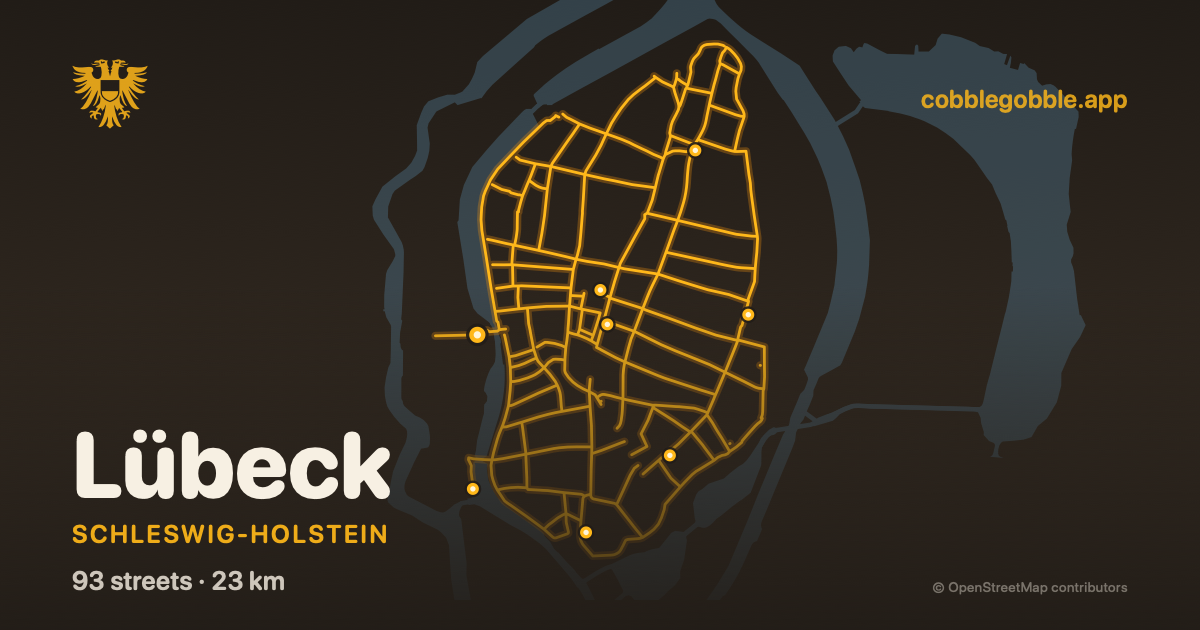
Use this map in your article or blog: free, with a credit link.
The game
Your first city is free.
Cobble Gobble is a walking game for iPhone. Claim any city as your free one. Every other city is a one-time purchase you keep for good, Family Sharing included, and a city you own plays fully offline.