North Rhine-Westphalia · Old Town
Cologne Old Town, street by street
A self-guided walking tour of the Cologne Old Town, every street in two days.
Every street on the menu.
Every street in the Old Town of Cologne is a line of dots you collect by walking it. I have been lying in one of them for six hundred years and I am still not finished.

At a glance
Plan your walk.
- Distance
- 29.2 km
- Time
- about 8.5 hours
- Streets
- 124
- Steps
- 3 streets with steps
- Start point
- Kölner Dom
- Short on time
- Cologne in one walk: 8 sights in a loop
- Phone needed while walking
- no
- Works offline
- yes
- Expires
- never
How long does it take to walk Cologne's Old Town?
About 8.5 hours at a stroll to cover all 124 streets, 29.2 km on foot, in two days.
Is Cologne's Old Town walkable?
Yes. The Old Town of Cologne is 124 streets and 29.2 km of walking end to end. 3 of them include a stretch of steps.
The Old Town
Map of the Cologne Old Town: every street, drawn.
Every lane inside that line is a course. The circles are fruit.
Landmarks
Sights in Cologne: what I would eat first.
Landmarks are fruit. The bigger the sight, the bigger the bonus.
Kölner Dom 1,500 points
The twin towers on every postcard of the city. 533 steps take you to a viewing platform about 100 metres up, and one of its bells weighs as much as 6 or 7 rhinos. The part I like best is inside. I am not telling you which.
Dufthaus 4711 500 points
4711. Four digits in the Altstadt, world famous on perfume bottles. Come by on the hour, between 9 in the morning and 7 at night, and look up.
Historisches Rathaus 500 points
A tower 61 m tall, built from 1407 to 1414, carrying 124 statues, with a Renaissance loggia from 1569 out front. Under it lie parts of the Roman governor's palace, found in 1953. Look up at the tower when the clock strikes.
Hohenzollernbrücke 500 points
The bridge right behind the Dom. Bridges are chewy, and this one is the chewiest I know. Walk out along the footpath and look closely at the fence. I am not explaining.
Groß Sankt Martin 250 points
The square crossing tower, 75 m tall, that shapes the skyline together with the Dom. Since 2009 it has been a monastery church again, after more than 200 years. The best of it is underneath.
Hahnentorburg 250 points
The gate at the Rudolfplatz, right where my meal ends at the Ring. The main road out of the city ran through here. Today the city holds weddings in the big room in the middle, and the EhrenGarde, a Cologne carnival corps, keeps its museum in the north tower. The gate has a couple of odd stories. I am keeping them.
Helenenturm 250 points
A 10-metre tower of the ancient city wall. Not all of it is as old as it looks, and what it was used for later is the best fact in the neighbourhood. I am not telling you what.
Neumarkt 250 points
A square is basically crust. This one has about 28,000 sq m of it. Look up at the roofs around it, and at a tower nearby.
Eating
What to eat in Cologne: actual food.
Cologne has no single signature dish. It has a dialect, and the old Rhineland plates go by dialect names that keep a straight face about what is on them. Potatoes, apples, rye rolls, blood sausage and beet syrup do most of the work. I read the name first. Then I eat what it means.
Meat and fish
Himmel un Ääd
Heaven is the apples up in the tree. Earth is the potatoes in the ground. Cologne mashes the two together and lays crisp fried blood sausage and roasted onions on top. Two layers and a crust. I know that kind of ground.
Sources: koeln.de, Express, Mit Vergnügen Köln
Flönz
Flönz is Cologne's word for blood sausage, and the EU has protected the name since 2016. Served on a rye roll with onion rings and mustard, the city calls the plate its caviar. Nobody here blinks.
Sources: European Commission, koeln.de, Mit Vergnügen Köln
Rheinischer Sauerbraten
Meat left for days in a marinade of vinegar and water. It turns Rhenish when apple or beet syrup sweetens it. It used to be made with horse, and only a few houses in Cologne still serve it that way.
Ask what meat it is before you order.
Sources: koeln.de, Kölner Stadt-Anzeiger, Mit Vergnügen Köln
Vegetarian
Halve Hahn
Order half a chicken and a rye roll arrives, with butter, a thick slice of medium-aged Gouda, mustard and onion. No bird was involved at any point. Visitors keep looking for it anyway.
Sources: koeln.de, Express, Mit Vergnügen Köln, Universität zu Köln
Reibekuchen
Grated potato, fried flat. Cologne calls them Rievkooche and eats them with fresh apple sauce or beet syrup. A Christmas market or a fair here without a stall frying them is not really one.
Eat vegan? Ask whether the batter has egg in it.
Sources: Kölner Stadt-Anzeiger, Mit Vergnügen Köln, koeln.de
Muuzemändelcher
Small sweet pieces of shortcrust, shaped like a drop or an almond and fried in hot fat. Cologne snacks on them from New Year's Eve to carnival, which in this city is a whole season, not a day.
Sources: koeln.de, Mit Vergnügen Köln, Kölnische Rundschau
Vegan
One dish, on purpose. The rest of Cologne's old table is blood sausage, a cheese roll and potato cakes bound with egg. The beet syrup is the one traditional thing on these lists with nothing from an animal in it.
Rheinisches Rübenkraut
A sugar beet syrup from the Rhineland, its name protected by the EU since 2012. Cologne pours it over Reibekuchen and uses it to sweeten a Sauerbraten. To me it is a spread with a pedigree.
Ask whether the Reibekuchen under it has egg in the batter.
Sources: European Commission, Kölner Stadt-Anzeiger, koeln.de
Late breakfast
About Coffee where locals go
Glockengasse 68
On the Glockengasse, just off the shopping streets, where the city paper noted there was hardly anywhere to have breakfast. Now there is. The coffee comes from One Take, a roaster in Hamburg, and nearly the whole breakfast card is made without animal products. The pancake batter too. I read that sentence twice.
- Mon09:00–17:00
- Tue09:00–17:00
- Wed09:00–17:00
- Thu09:00–17:00
- Fri09:00–17:00
- Sat10:00–18:00
- Sunclosed
Come for breakfast before three on a weekday, or before four on a Saturday. That is when the kitchen closes.
Sources: Kölner Stadt-Anzeiger
Café Kogi where locals go
Auf dem Berlich 7
Auf dem Berlich, one street off the shopping crush, with a courtyard behind it that nobody would guess at from the pavement. Magnolias, lavender, roses, and breakfast from the morning on: croissants, rolls, eggs, muesli. The beans come from the Kogi region of Colombia, and the café carries the name. Flowers on one side, eggs on the other. I face the eggs.
- Mon09:30–18:00
- Tue09:30–18:00
- Wed09:30–18:00
- Thu09:30–18:00
- Fri09:30–18:00
- Sat10:00–18:00
- Sun10:00–18:00
Sources: Kölner Stadt-Anzeiger, Mit Vergnügen Köln
Adeli where locals go
Venloer Straße 19
On the Venloer Straße, at the top edge of the Belgian Quarter, near the Stadtgarten. Bagels are the house's strong suit, and there is a gallery level up the stairs to eat them on. Breakfast runs all day, on bread from Bergheim, a Cologne bakery. That suits me. I keep geological hours.
- Mon09:00–18:00
- Tue09:00–18:00
- Wed09:00–18:00
- Thu09:00–18:00
- Fri09:00–18:00
- Sat10:00–18:00
- Sun10:00–18:00
Sources: Mit Vergnügen Köln, Kölner Stadt-Anzeiger
Afternoon coffee
Miss Päpki where locals go
Rudolfplatz 2
A café on the Rudolfplatz, a few steps from the Hahnentor. It moved here from the Brüsseler Platz in 2026 and brought what mattered: coffee from the Cologne roaster Schamong, cakes made in house, small savoury things beside them. A move that kept the recipe. I approve.
- Mon10:00–18:30
- Tue10:00–18:30
- Wed10:00–18:30
- Thu10:00–18:30
- Fri10:00–18:30
- Sat10:00–18:30
- Sunclosed
Sources: Der Feinschmecker, Kölner Stadt-Anzeiger, Mit Vergnügen Köln
hommage where locals go
Friesenstraße 73-75
A few square metres on the Friesenstraße, furnished with old pieces that each come with a past. The house roasts its own beans, and the cake selection is the kind people fall for. Old furniture, fresh cake. That is the right order of ages.
- Mon08:00–18:00
- Tue08:00–18:00
- Wed08:00–18:00
- Thu08:00–18:00
- Fri08:00–18:00
- Sat08:00–18:00
- Sun10:00–18:00
Sources: Mit Vergnügen Köln, Kölner Stadt-Anzeiger, koeln.de
People People Coffee where locals go
Maastrichter Straße 24
In the Belgian Quarter, just outside the Ring, on the Maastrichter Straße. The beans are guests, and they come with names: Tim Wendelboe from Oslo, Coffee Collective from Copenhagen, La Cabra from Aarhus. They go through the filter as well as the espresso machine. A filter takes a few minutes. I have those.
- Mon08:30–18:30
- Tue08:30–18:30
- Wed08:30–18:30
- Thu08:30–18:30
- Fri08:30–18:30
- Sat10:00–18:00
- Sun10:00–18:00
Sources: European Coffee Trip
Dinner
Chum Chay where locals go
Friesenwall 29
Vegetarian Vietnamese, tucked into a courtyard off the Friesenwall that you cannot see from the street. Inside are wooden benches and an open kitchen you can watch at work, and two city magazines call the prices low. People queue for a table at lunch and at dinner, and the city paper's critic says the banana blossom salad is worth the wait. A salad with a queue in front of it. That is a review on its own.
- Mon12:00–22:00
- Tue12:00–22:00
- Wed12:00–22:00
- Thu12:00–22:00
- Fri12:00–22:00
- Sat12:00–22:00
- Sunclosed
Bring cash.
Sources: Mit Vergnügen Köln, Stadtrevue, Kölner Stadt-Anzeiger
Bai Lu Noodles where locals go
Palmstraße 41
A small noodle place on the Palmstraße, bright and cosy, open since 2020. The kitchen makes its own noodles and serves them in broth, and the city paper's critic called the broths fabulous. A chef with a Michelin star tipped the noodle soups here in a city magazine. Broth first, then the noodles. Then the rest of the broth.
- Mon11:30–22:30
- Tue11:30–22:30
- Wed11:30–22:30
- Thu11:30–22:30
- Fri11:30–23:30
- Sat11:30–23:30
- Sunclosed
Sources: Kölner Stadt-Anzeiger, Mit Vergnügen Köln, Stadtrevue
Warung Bayu where locals go
Brabanter Straße 5
Balinese cooking in the Belgian Quarter, in a basement room that its plain front gives no hint of: low light, dark wood, a lot of green. A warung is a small, simple restaurant, and this one cooks across Indonesia with Bali at the centre. The city paper's critic and a city magazine both pick number 265: crisp tofu with green beans and aubergine in garlic and chili, with peanut sauce. No dialect name to decode here. Just a number.
- Mon18:00–23:00
- Tue18:00–23:00
- Wed18:00–23:00
- Thu18:00–23:00
- Fri18:00–23:00
- Sat18:00–23:00
- Sun18:00–23:00
Want the courtyard on a warm evening? Reserve a seat.
Sources: Kölner Stadt-Anzeiger, Mit Vergnügen Köln, koeln.de
Checked 25 October 2026.
With kids
Cologne with kids: short legs, big appetite.
The streets here are full of dots to collect, and a child on a hunt forgets to be tired. Here is a short loop for the smallest walkers.
- The loop
- Kölner Dom, Dufthaus 4711, Hohenzollernbrücke, and back to the start
- Distance
- 2.0 km
- Time
- about 40 minutes of walking at a child's pace (3 km/h)
- Steps
- no streets with steps on the loop
- Playgrounds
- 1 near the loop
- Public toilets
- 5 near the loop
- Drinking water
- 1 near the loop
- Ice cream
- 2 near the loop
Near the loop means within 150 m of it, counted from OpenStreetMap, © OpenStreetMap contributors.
Name origin
Why it is called Cologne.
Cologne's name comes from Colonia, the first word of the city's Roman name. In full that was Colonia Claudia Ara Agrippinensium, CCAA for short: the Claudian colony and altar of the Agrippinensians. Agrippina was born here and got her husband, Emperor Claudius, to give the town that rank and that name. Four words, and the city kept one. I would have eaten all four.
Sources: Stadt Köln, Agrippina – der intelligente Chatbot für Ihre Anliegen; Stadt Köln, Das Kölner Rathaus (Broschüre) p. 4; LVR (KuLaDig), Agrippastraße im Griechenmarktviertel; Römisch-Germanisches Museum, Agrippina – Kaiserin aus Köln
Why here
Somebody stood here and decided.
Right on the Rhine. The Romans laid the town out on the ground of today's Altstadt, close to the river. In Roman times a side arm of the Rhine ran where the Alter Markt and the Heumarkt are now and sheltered the harbour. The Rhine was the road for ships, and the water route was 60 times cheaper than the land route. A town that gets its groceries by boat has thought things through.
Sources: Römisch-Germanisches Museum, Agrippina – Kaiserin aus Köln; LVR (KuLaDig), Rhein in Nordrhein-Westfalen; LVR (KuLaDig), Abschnitt der römischen Hafenstraße am heutigen Roncalliplatz
Why then
When the first stone went down.
The town is older than its name: Augustus founded it in the last decades BC. Its big day came in 50 AD, when Emperor Claudius, at the wish of his wife Agrippina, who was born here, gave it the highest Roman city rank and made it a colony. A promotion after a few decades. I have lain in the same lane for centuries and nobody has promoted me once.
Sources: Römisch-Germanisches Museum, Agrippina – Kaiserin aus Köln; Stadt Köln, Das Kölner Rathaus (Broschüre) p. 4; Stadt Köln, Agrippina – der intelligente Chatbot für Ihre Anliegen
Who ruled
Everyone who thought they owned this.
I outlasted all of them. It is the one thing I am good at.
- 1475–1794
Cologne grew into one of the most important centres of the Holy Roman Empire, and on 19 September 1475 it became a Free Imperial City. It stayed one until the French arrived in 1794. More than three centuries of writing its own menu.
- 1794–1814
From 1794 to 1814 Cologne was French. The French state even owned the town hall, until Napoleon gave it back to the city in April 1811. Kind of him. I would have kept it. A town hall is a very filling building.
Sources: Stadt Köln, Der Gürzenich – Kölns gute Stube; Stadt Köln, Das Kölner Rathaus (Broschüre) p. 5
- 1815–1871
The Congress of Vienna gave Cologne to Prussia in 1815. In 1842 King Friedrich Wilhelm IV of Prussia laid the foundation stone to complete the Dom. Finishing a meal somebody else started. The best kind of meal.
Sources: Stadt Köln, Das Kölner Rathaus (Broschüre) p. 5; Hohe Domkirche zu Köln, Geschichte; Stadt Köln, Der Gürzenich – Kölns gute Stube
The emblem
What the shield means.
Three gold crowns on red, over eleven black flames on silver. The crowns are the Three Kings: their relics mattered so much to the city that it put the three crowns in its arms, and the oldest surviving picture of the arms is in the upper windows of the Dom's choir, made around 1300. From the early 15th century the crowns were the city's trademark too. The eleven flames belong to the cult of St Ursula; the tourist board reads them as ermine tails, for Ursula and her 11 or 11,000 companions. Eleven or eleven thousand. Either way, a lot of mouths to feed.
Sources: Wikipedia (DE), Kölner Wappen; Hohe Domkirche zu Köln, Die Heiligen Drei Könige; Kölnisches Stadtmuseum, Lehrmaterial Museumsbus Stadtmuseum p. 1; Stadt Köln, Skulpturen des vierten Obergeschosses; KölnTourismus GmbH, St. Ursula Köln: romanische Kirche mit der Goldenen Kammer
Emblem: Public domain — official coat of arms (Wikimedia Commons)
Three facts
Three things I know about this place.
On the Domplatte, at the corner of Unter Fettenhennen and Trankgasse, a side passage of the Roman north gate and the remains of its foundations are free to walk up to. The whole gate had three arches and was about 30 metres wide. On the west side of the rebuilt part you can still see the groove the portcullis of the middle passage ran in. The central arch, with the letters CCAA cut into it, is inside the Römisch-Germanisches Museum. That gate has stood here longer than I have. I am trying not to be jealous.
Between the Römisch-Germanisches Museum and its office building, a stretch of the Roman harbour street is free to walk on. It is still 6 metres wide, and its basalt paving dates from the 3rd or 4th century. Basalt stones, laid tight. That is family. I eat it respectfully.
Sources: LVR (KuLaDig), Abschnitt der römischen Hafenstraße am heutigen Roncalliplatz
In the middle of the 15th century the city council built a 'new Kaufhaus', a hall for trade, and called it the Gürzenich. From 1452 the banquets after the mayoral elections were held there. Goods and a banquet under one roof. My kind of building.
Street words
What the names on the signs mean.
- Altstadt
- The Old Town. Here it means the old core inside the Ring, from the Rhine to the Hohenzollernring. The whole level, and the whole meal.
- Gasse
- A lane, usually a narrow one: Glockengasse, Bechergasse, Hühnergasse. Narrow is good. Narrow means more bites per metre.
- Markt
- A market square: Alter Markt, Heumarkt, Neumarkt, Fischmarkt, Buttermarkt. It reads like a shopping list, and I read it that way.
- Unter
- In a street name here, 'Unter' often goes with a trade: Unter Goldschmied, Unter Taschenmacher, among the goldsmiths, among the bag makers. The trades are in the names. The streets are on my plate.
The size of it
Walk it in two days: Cologne in numbers.
Counted from the streets in the level itself, not from a guidebook.
- 124streets
- 1,518dots
- 23.4km of street
- 29.2km on foot
- 8.5hours at a stroll
23% of the streets here, by length, are cobbles or setts: number 38 of 59 Old Towns measured.
Nearby
Old Towns close to this one.
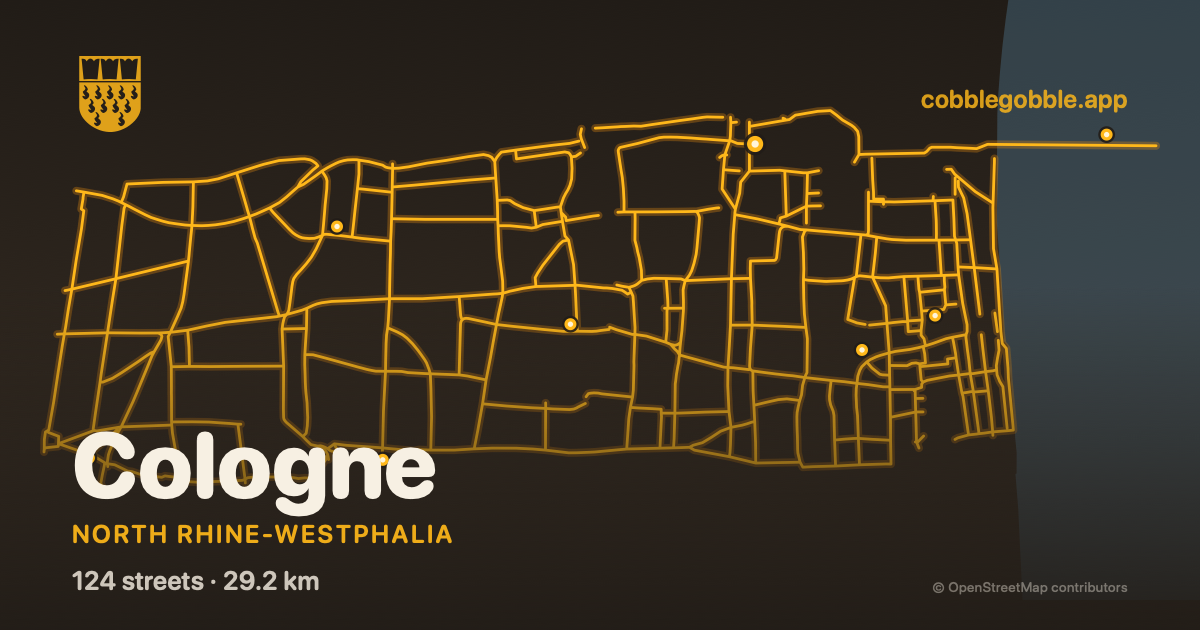
Use this map in your article or blog: free, with a credit link.
The game
Your first city is free.
Cobble Gobble is a walking game for iPhone. Claim any city as your free one. Every other city is a one-time purchase you keep for good, Family Sharing included, and a city you own plays fully offline.