Greece · Old Town
Athens Old Town, street by street
A self-guided walking tour of the Athens Old Town, every street in one day.
Every street on the menu.
Every street in the Old Town of Athens is a line of dots you collect by walking it. I have been lying in one of them for six hundred years and I am still not finished.

At a glance
Plan your walk.
- Distance
- 21.4 km
- Time
- about 6 hours
- Streets
- 122
- Steps
- 3 streets with steps
- Start point
- Plateia Syntagmatos
- Short on time
- Athens in one walk: 8 sights in a loop
- Phone needed while walking
- no
- Works offline
- yes
- Expires
- never
How long does it take to walk Athens's Old Town?
About 6 hours at a stroll to cover all 122 streets, 21.4 km on foot, in one day.
Is Athens's Old Town walkable?
Yes. The Old Town of Athens is 122 streets and 21.4 km of walking end to end. 3 of them include a stretch of steps.
The Old Town
Map of the Athens Old Town: every street, drawn.
Every lane inside that line is a course. The circles are fruit.

Landmarks
Sights in Athens: what I would eat first.
Landmarks are fruit. The bigger the sight, the bigger the bonus.
Plateia Syntagmatos 1,500 points
Plateia Syntagmatos on your map. At the top end of the square two men stand very still, dressed like nobody else in Athens, and now and then they move. It is worth waiting for. The square's name is a single word a crowd once demanded. I also stand very still. Nobody gathers to look at me.
Mitropolitikos Naos Athinon 500 points
Plateia Mitropoleos on your map: a large church on a large square, and right beside it a very small one. The city has a saying about the pair, and it is not really about buildings. The large one has a past of its own: what went into its walls, and where it was supposed to stand. I eat the square between them and leave both.
Panagia Kapnikarea 500 points
A small church sitting in the middle of a street: Kapnikarea on your map. Why it is still there is a story with a royal family in it. Its name is a riddle with money in it, and the art inside is far younger than the walls. Three answers, and I am keeping all of them.
Poikili Stoa 500 points
Poikili Stoa on your map. From Adrianou you look over a fence into a dig: foundations, a few stone blocks, nothing that shouts. A word you have almost certainly used started in these few stones. Which one, I am not telling. Stones are good at keeping things to themselves. I would know.
Ethniko Istoriko Mouseio 250 points
Ethniko Istoriko Mouseio on your map: a grand old house on Stadiou with a horseman on a pedestal in front of it. Look at which way he is turned, then at his arm: the city made a joke out of the pair, and I am keeping it for when you get there. The joke stands outside, so it needs no ticket. Neither do I.
Plateia Koumoundourou 250 points
Koumoundourou Square looks like an ordinary city square. Ordinary squares are my favourite: a whole plate of stone at once. This one has had more lives than it lets on, and a newspaper once poked fun at what people were calling it. That is all I am saying.
Tzami Tzistaraki 250 points
Tzami Tzistaraki on your map, standing on Monastiraki Square under a dome, with the square's crowd all round it. The man who put it up made one choice of material that cost him dearly. I am not saying which. I take building material seriously too.
Varvakeios Agora 250 points
The city's central market, Varvakeios Agora on your map. Noise everywhere, and a name for the place that the city borrowed from another one. The market's own name goes back to a man who got rich in a way you would not guess, a long sea journey from here. I eat only the street outside. The rest is yours to look at.

Eating
What to eat in Athens: actual food.
Athens eats by the church calendar. In the fasting weeks the city gives up meat and every animal product, and the tables fill with dishes cooked in olive oil: beans, bean soup, stuffed vegetables. On 25 March it eats salt cod. And for decades a long night ended with tripe soup at the Varvakeios. I keep no calendar. I eat streets on every day of the year.
Meat and fish
Bakaliaros skordalia
Salt cod, fried, with skordalia, a thick garlic sauce. It is the traditional dish of 25 March, the feast of the Annunciation, and every spring the city's papers print where to find it. I have no nose. On 25 March in Athens, that is a loss.
Sources: Athens Voice, CNN Greece, in.gr
Souvlaki
Grilled meat on a skewer, or rolled up in a pita as a tylichto, a wrap. One history piece calls it perhaps one of the only Greek dishes that started in Athens and not in the provinces. In 2026 Kathimerini's food magazine counted nine new shops that know how a proper wrap is made. A skewer is a street for meat, end to end.
Sources: Gastronomos (Kathimerini), LiFO, alfavita.gr
Patsas
Tripe soup. For decades one of the strongest habits of Athens nightlife was closing the evening with patsas at the Varvakeios market, in the small hours. I am awake at that hour too. I am awake at every hour.
Sources: Athens Voice, Greek Gastronomy Guide, travel.gr
Vegetarian
Two, on purpose. Most of Athens' meatless cooking is fasting food, nistisima, which leaves out every animal product, so it sits in the vegan band. These two keep their cheese and their honey.
Loukoumades
Little balls of dough, crisp outside and soaked in syrup or honey, sprinkled with cinnamon and sesame. To Vima counts them among the most loved desserts in Greece, with a history that runs back millennia. Round, like me. That is where the likeness ends.
Sources: iefimerida.gr, To Vima, Athens Voice
Tyropita
Cheese pie, in filo, kourou or puff pastry. travel.gr calls it the most famous breakfast there is, and a LiFO writer keeps a list of her seven favourites. Layer on layer. Old roads are built the same way.
Sources: travel.gr, LiFO, Athens Voice
Vegan
Fasolada
White-bean soup with carrot, onion, celery, tomato and oil. Greek City Times says it is often called the national food of the Greeks, and very popular in Lent, when the fast leaves out meat and every animal product. A national dish made of beans and patience. I have plenty of the second.
Ask for it nistisimi, the fasting version, so nothing from an animal goes in the pot.
Sources: Greek City Times, Gastronomos (Kathimerini), iefimerida.gr, Athens Voice
Gemista
Tomatoes and peppers stuffed with rice, herbs and onion, cooked in good olive oil. One Athens list adds fresh mint, another pulls them from a wood oven. They are ladera, the dishes cooked in olive oil. Emptied out and filled again. Streets get the same treatment whenever the pipes are redone.
Ask whether the filling is rice only. That is the vegan one.
Sources: iefimerida.gr, LiFO, travel.gr
Gigantes
Giant white beans, baked slowly in the oven until, iefimerida says, they go as soft as loukoumi. Athens Voice finds them among the classics at an old taverna in Exarchia. Their name means giants. For a bean, that takes nerve.
Sources: iefimerida.gr, Athens Voice, travel.gr
Late breakfast
Diporto where locals go
Sokratous 9
A basement room at the corner of Sokratous and Theatrou, a few steps from the market. Sprudge calls it an Athens staple: simple, home-cooked plates, and Athens Voice names fasolada, salt cod, sardines, potato stew and orzo giouvetsi. Athinorama sees people who work at the Varvakeios at the tables, tourists too, young and old. The stairs go down. I wait at the top, which I am good at.
- Mon08:00–17:00
- Tue08:00–17:00
- Wed08:00–17:00
- Thu08:00–17:00
- Fri08:00–17:00
- Sat12:00–17:00
- Sunclosed
Come at midday. It is a lunch house: the door shuts at 17:00, and on Sunday it stays shut.
Sources: Sprudge, Athens Voice, Athinorama
Holy Llama where locals go
Nikis 23
On Nikis, a short way from Syntagma. Falstaff calls it a creative bakery: no animal products at all, traditional recipes and modern ones side by side, and breakfast on its list. The house serves brunch all day, with viennoiserie. Nothing from an animal in it. Same goes for me: stone, all the way down.
- Mon08:30–17:00
- Tue08:30–17:00
- Wed08:30–17:00
- Thu08:30–17:00
- Fri08:30–17:00
- Sat09:00–18:00
- Sun09:00–18:00
Sources: Falstaff
Usurum where locals go
Lepeniotou 19
On Lepeniotou, five minutes from Monastiraki by the house's own count. Its page lists brunch sweet and savoury, bowls, pancakes, vegan sandwiches, specialty coffee, juices and smoothies. There is a courtyard, open all year, and dogs may come. Walk-ins only. You carried me here on foot, so I count.
- Mon07:30–18:00
- Tue07:30–18:00
- Wed07:30–18:00
- Thu07:30–18:00
- Fri07:30–18:00
- Sat07:30–19:00
- Sun07:30–19:00
Come before 17:00 if you want to eat: the kitchen stops then. The door stays open until 18:00, and until 19:00 at the weekend.
No guide has reviewed it yet. It is here because it is owner-run, not expensive and rated 4.0 or better by its guests.
Afternoon coffee
Mokka the old one
Athinas 44
On Athinas, across the street from the market hall, and Popaganda has it at number 44 since 1922. Sprudge calls it the place in town for coffee boiled in a briki, the Greek way. In Your Pocket thinks it may have the biggest choice of coffee in the city. More than a hundred years at one door. I call that settling in.
- Mon06:00–17:00
- Tue06:00–17:00
- Wed06:00–17:00
- Thu06:00–17:00
- Fri06:00–17:00
- Sat06:00–17:00
- Sunclosed
Sources: Sprudge, In Your Pocket, Popaganda
Third Place come for the one thing: the canned cold brew
Apollonos 23B
Barista Magazine calls the cold brew, sold in a can, a must try. The café sits on the ground floor of a typical Athens apartment block from 1960, on Apollonos, and Protothema says locals took to it quickly. A can is a bollard with a lid. I know bollards well.
- Mon08:00–18:00
- Tue08:00–18:00
- Wed08:00–18:00
- Thu08:00–18:00
- Fri08:00–18:00
- Sat09:00–17:00
- Sunclosed
Sources: Barista Magazine, Protothema, LiFO
Myller where locals go
Katsikogianni 9
A corner café on Plateia Agion Anargyron in Psyrri, with most of its seats outside. travel.gr says the coffee is the star here, and that the owner has worked as a barista at a high level. Sprudge had a freddo cappuccino, then an Ethiopian made by hand on a dripper. The shop was a cobbler's once, and it kept the old name. A cobbler mended what my streets wore down.
- Mon09:00–20:00
- Tue09:00–20:00
- Wed09:00–20:00
- Thu09:00–20:00
- Fri09:00–20:00
- Sat09:00–20:00
- Sun09:00–20:00
Dinner
Feyrouz come for the one thing: the lachmatzoun
Agathonos 1
A tiny shop at the corner of Karori and Agathonos, cooking food from the region of Antioch. Greek City Times puts its lachmatzoun on a list of dishes worth trying in Athens: a thin flatbread that comes three ways, with minced beef, with seasonal vegetables on wholemeal dough, or on za'atar dough. Thin, round and baked flat. Some of my best friends are paving slabs.
- Mon12:00–18:00
- Tue12:00–22:00
- Wed12:00–18:00
- Thu12:00–22:00
- Fri12:00–22:00
- Sat12:00–22:00
- Sunclosed
Come early on Monday and Wednesday: it shuts at 18:00 on those days, and all day on Sunday.
Sources: Greek City Times, Athens Voice, Spotted by Locals
Atlantikos where locals go
Avliton 7
A small fish taverna hidden in Avliton, a narrow lane of Psyrri, with a few tables inside. Protothema counts ten dishes on the menu at most. iefimerida likes its salt cod, and is glad it serves it all year round and not only on 25 March. Ten dishes and one lane. I only need the lane.
- Mon13:00–01:00
- Tue13:00–01:00
- Wed13:00–01:00
- Thu13:00–01:00
- Fri13:00–01:00
- Sat13:00–01:00
- Sun13:00–01:00
Sources: iefimerida.gr, Protothema, Carry It Like Harry
Nikitas where locals go
Agion Anargyron 19
On Agion Anargyron, in Psyrri. It started in 1967, when the area was industrial, to feed the people who worked there, and travel.gr knows it for clean, tasty, cheap food. Athens Voice calls it the last refuge of the neighbourhood's old-timers and finds the real charm in the pots: fava, dolmades, chickpeas with orange, and moussaka made in house, which it says very few places do. travel.gr would drive kilometres for the biftekia. Kilometres of street, and not one bite taken.
- Mon12:00–19:00
- Tue12:00–19:00
- Wed12:00–19:00
- Thu12:00–19:00
- Fri12:00–23:00
- Sat12:00–23:00
- Sun12:00–19:00
An evening here means Friday or Saturday, when it stays open until 23:00. On the other five days it is gone by 19:00, so come early.
Sources: Athens Voice, travel.gr
Checked 3 November 2026.
With kids
Athens with kids: short legs, big appetite.
The streets here are full of dots to collect, and a child on a hunt forgets to be tired. Here is a short loop for the smallest walkers.
- The loop
- Plateia Syntagmatos, Tzami Tzistaraki, Mitropolitikos Naos Athinon, and back to the start
- Distance
- 1.7 km
- Time
- about 35 minutes of walking at a child's pace (3 km/h)
- Steps
- no streets with steps on the loop
- Playgrounds
- none on the map near the loop. The nearest is Paidiki Chara Akropoleos, about 390 m from the loop in a straight line
- Public toilets
- 2 near the loop
- Drinking water
- 1 near the loop
- Ice cream
- 18 near the loop
Near the loop means within 150 m of it, counted from OpenStreetMap, © OpenStreetMap contributors.

Name origin
Why it is called Athens.
Athens was Athenai in Ancient Greek, a plural, and its root is probably not Greek at all, possibly a leftover of whoever lived in Attica before. Whether the city was named after its goddess or the goddess after the city was argued already in antiquity. Scholars now mostly say the goddess took the city's name, because the ending is common for locations and rare for persons. Since the 1960s at the latest, Greek says Athína, in the singular. I liked the plural better. More than one Athens means more streets for me.
Sources: en.wikipedia.org; de.wikipedia.org

Why here
Somebody stood here and decided.
On a steep rock you can only climb from the west, in the widest plain of Attica, with mountains on three sides and the sea on the fourth. The oldest town fitted on the flat top of that hill. Water was the other reason: the Klepsydra spring sits on its north-west slope, with about 20 shallow wells from the earliest settlers just below it, and an earthquake once opened a crack in the rock some 35 m deep, with a well dug at the bottom. People came for the water. I am here for the streets north of it: Monastiraki, Psyrri, the market.
Sources: de.wikipedia.org; www.britannica.com; en.wikipedia.org; odysseus.culture.gr

Why then
When the first stone went down.
Before anyone wrote it down. Pottery shows people on the hill in the Neolithic, 4000/3500 to 3000 BC, and the municipality says the city has never been empty since. In the 13th century BC a wall went round the top and the hill became the centre of a Mycenaean kingdom. Tradition credits Theseus with joining the 12 towns of Attica under Athens. Theseus is a legend. The wall, huge blocks laid without mortar, was not.
Sources: odysseus.culture.gr; www.cityofathens.gr; www.britannica.com; de.wikipedia.org

Who ruled
Everyone who thought they owned this.
I outlasted all of them. It is the one thing I am good at.
- 560–510 BC
Peisistratos and his sons. Under him, in the middle of the 6th century BC, the holy hill had its first monumental buildings, and the city got its greatest religious festival, the Panathinaia. A festival and a building site at once. Both belong to the hill. I stick to the streets.
Sources: odysseus.culture.gr; www.britannica.com
- 450–400 BC
Perikles started a building programme on the rock that took the entire second half of the 5th century BC. Half a century of building on one hill. Anyone who puts that much stone in one place has my respect.
Sources: odysseus.culture.gr
- 1204–1456
Frankish lords from the west held Athens, and the grand gateway to the rock, the Propylaia, became the residence of the Frankish ruler. A front door turned into a house. Streets do odd things too, but rarely that.
Sources: odysseus.culture.gr
- 1456–1833
Then the city answered to the sultans, and the same gateway became the garrison's headquarters. The rock was handed back to the Greeks in 1822, the rest of the city some years later.
Sources: odysseus.culture.gr
- 1834–
In 1834 Athens became the capital of the newly independent Greek state, though it was then a town of about 4,000 people, a loose swarm of houses at the foot of the rock. King Otto, the first King of Greece, had a modern city plan drawn, fit for a capital. A whole new grid of streets at once. My kind of king.
Sources: www.cityofathens.gr; en.wikipedia.org; de.wikipedia.org
The emblem
What the shield means.
My glyph is the head of Athena, the city's patron goddess. On the flag of Athens, adopted in 1995, her head sits on a blue disc framed with gold olive branches, and the disc sits on a white cross. The city logo launched under mayor Avramopoulos pairs a huge cross with a smaller head of the goddess. Athena was on the community's seal as early as 1821, back then as a whole figure with her spear, the owl and olive branches. I kept the head. A whole goddess does not fit on a rock my size.
Sources: flagspot.net; el.wikipedia.org; mikropragmata.lifo.gr; helios.eie.gr p. 9; odysseus.culture.gr
Emblem: Original artwork for Cobble Gobble — no third-party source

Three facts
Three things I know about this place.
On Areos, in Monastiraki, you pass the walls of Hadrian's Library, built by the emperor in AD 132. From the pavement you see its west side, with the Corinthian gateway. Behind that wall lay an open courtyard ringed with columns, and in the 5th century a church shaped like a four-leaf clover went up in the middle of it. A library is wasted on me. The street beside it is not.
Sources: odysseus.culture.gr; odysseus.culture.gr
Monastiraki means little monastery, and the whole district is named after one church on Plateia Monastirakiou, the Pantanassa. A patriarchal document of 1678 calls it the main church of a convent, known then as the Great Monastery; when the convent declined, the small name took over and spread to the area around it. Today the church sits well below the square, because the ground around it was reshaped. The church stayed put and the square went up. I side with the square.
Sources: en.wikipedia.org; athensattica.com
Psyrri's central square is Plateia Iroon, Heroes' Square, after the names of streets that lead into it: Miaouli and Karaiskaki are named for heroes of the Greek War of Independence. Five main streets of the district end at the square; the other three are Agion Anargyron, Aristofanous and Aischylou. Five streets served on one square. I start with the heroes.
Sources: en.wikipedia.org; el.wikipedia.org
Street words
What the names on the signs mean.
- Plateia
- A square, as in Plateia Monastirakiou. When a sign says Plateia, the street has stopped being thin. Good news, in my experience.
- Stoa
- A covered shopping arcade. Eight of them are streets on this map, Stoa Emporon and Stoa Pyrrou among them. A roof over a street does not bother me.
- Agiou / Agias
- Of Saint …: the street is named for a church, as on Agiou Dimitriou and Agias Eirinis.
- Adrianou
- Of Hadrian. Street names here are genitives, and the word for street is simply left out. I would never leave out a street.
The size of it
Walk it in a day: Athens in numbers.
Counted from the streets in the level itself, not from a guidebook.
- 122streets
- 1,062dots
- 17.6km of street
- 21.4km on foot
- 6hours at a stroll
2% of the streets here, by length, are cobbles or setts: number 59 of 59 Old Towns measured.
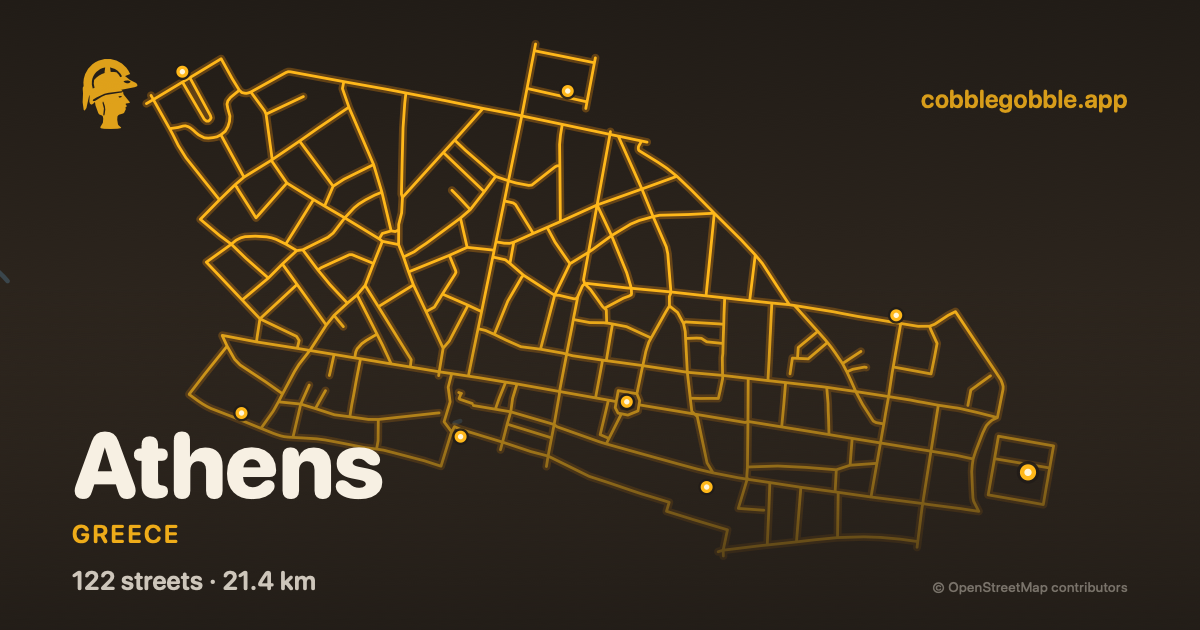
Use this map in your article or blog: free, with a credit link.
The game
Your first city is free.
Cobble Gobble is a walking game for iPhone. Claim any city as your free one. Every other city is a one-time purchase you keep for good, Family Sharing included, and a city you own plays fully offline.